The architecture of simplicity

Identity Oriented Architecture

What if complexity did not exist?

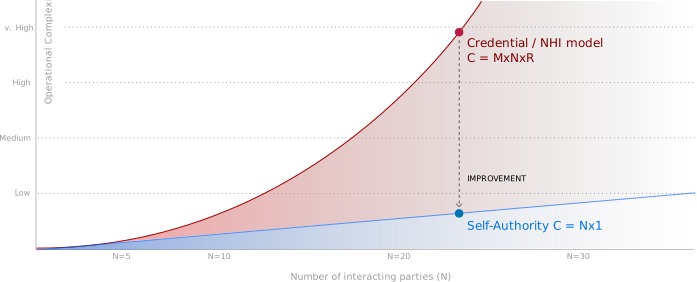
Credential complexity is not a management problem. It is what credential architecture always produces - geometrically, with every new actor, service, and rotation cycle added to the system. The only way to escape it is to remove the architecture that generates it.

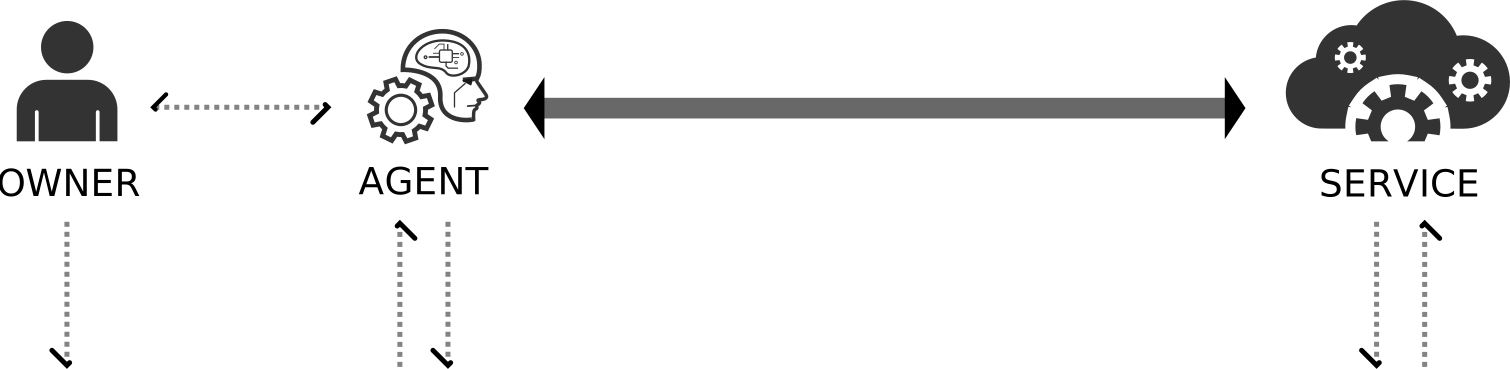
Identity Oriented Architecture replaces the credential substrate entirely. Each actor - human, device, or AI agent - carries one self-asserted cryptographic identity. One identity connects to any number of services. Rotation, provisioning, and lifecycle management are properties of the certificate, not of your team's time.

The model is grounded in scientific research and institutionally validated. It's not a vendor abstraction, but a formally reasoned architectural shift.

Awardable in Tradewinds CDAO

post-competition, readily awardable solution pitch videos that address the Department of Defense's (DoD) most significant challenges in AI and ML ( Registered US Gov. Entities only  )

Independently Validated

Published
Openly

The 12 Principles of Agentic Identity defines the architectural foundation for accountable autonomous systems.

Pioneering Identity Model (IOA)

Understand why complexity collapses when we shift from a credential oriented architecture to an Identity Oriented Architecture

The choice between having to mange hundreds ( N×1 ) vs. hundres of thousands ( N×M×R ) of combinations comes down to system architecture not management style.
Security as a state, not a chore

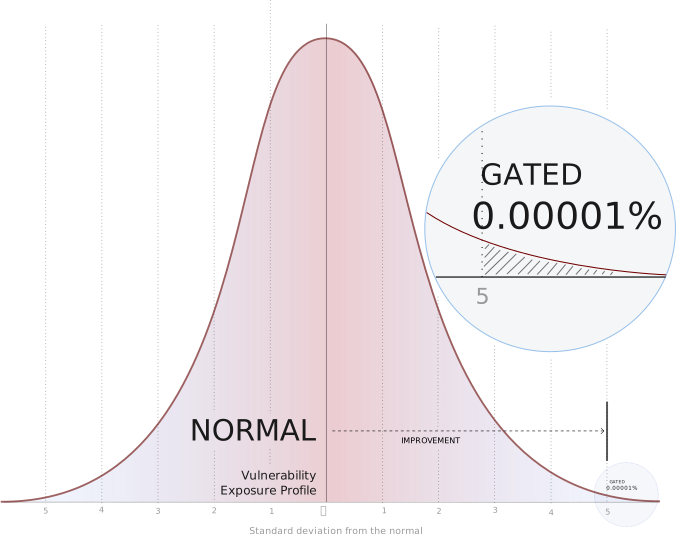
Reversing the order of authentication from connect, then authenticate to authenticate to connect - having to talk to any device vs. knowing legitimate devices - has a profound positive effect on security posture. It practically reduces vulnerability exposure risk to less than a rounding error.

Identity Gated Execution

Eliminate 99.99999% of your vulnerability risk through architecture - before any application security tooling

mTLS is the only point in the entire network stack where security and identity converge at the protocol layer. Authentication happens at TCP/TLS - before any session, before any application data, before any protocol is negotiated.

Unknown actors are not monitored, not flagged, not detected after the fact. They are structurally excluded at connection. The probability that an unidentified entity reaches your systems is not a risk management problem - it is a statistical artefact at the 5-sigma boundary.

This is not a defence posture. It is an architectural property. You do not fight attackers - you remove the conditions that allow unknown actors to connect at all.

Mutual TLS
( mTLS ) native

The first Identity and Access Control Platform built entirely and natively on mutual TLS - the industry gold standard for security

Market Signal

I want certificates everywhere!

( CEO of consumer logistics company after suffering economic DOS attack on SMS verification )

mTLS is the number one feature request by major buyers in the financial sector!

( Field CTO of major data-lake solution provider )

Migrate on your own terms

Past, Present & Future Compatible

Sits alongside your existing infrastructure

Identity Plus is not a credential management module or an IAM extension. It is a sovereign, stand-alone identity infrastructure - built from the ground up with interoperability as a core architectural tenet, not an afterthought.

Mutual TLS is the most widely deployed communication protocol on the Internet. It is compatible out of the box with every programming language and most applications. Where native support is absent, Identity Plus provides integration tooling on both the identity and access sides - so the transition is on your terms, not the protocol's.

Adoption is gradual by design. Enrolled systems retain full compatibility with existing processes, workflows, and technology stacks. You extend your infrastructure. You do not replace it.

Explore the Self-Authority Platform

REST API
Integration

Independent, Identity, and Access Control application level integrations, compatible with any SDK

Automation Ready
CLI

Self-provision X.509 Certificates in CI / CD pipeline with OS agnostic command line interface

Mutual TLS Tunnelling
with mTLS Persona

Give any TCP legacy client mTLS ID with no code modifications using the mTLS Forwarder

Turnkey IGE with
mTLS Gateway

Gate any HTTP / TCP legacy service for mTLS based, X.509 client certificate authentication with no code changes

mTLS SSO Into
OIDC / OAuth2 Apps

Translate mTLS Identity native authentication to portable credential based corporate single sign on

Active Directory
Aligned

Map mTLS based organizational relationships to Active Directory corporate structure.

The Independence of Functions

Self-Authority

One platform, two independent products - security and operations of identity functions no longer depend on a 2nd party

mTLS Identity

Self-asserted cryptographic identity for every actor in digital space

X.509 certificates at scale. One model for any actor - human, device, or AI agent. The ownership chain is cryptographic, not procedural, and indepent of any service.

  • Self-provisioned X.509 certificates lifecycle - agent owned
  • Uniform across all actors - human, machine, sub-agent
  • Explicit delegation - part of authority chain
  • C = N×1 - Linear complexity regardless of scale

Explore mTLS Identity

mTLS Perimeter

No identity, no connection - no connection, no exposure

Authentication at TCP/TLS - before any data, any session, any application protocol. Unknown actors are structurally excluded at connection.

  • Connection layer continuous auth - no cookies, no tokens, no API keys
  • Unknown actors excluded from reaching vulnerabilities
  • Cryptographic attribution in every request - not from logs
  • Equally secure for every actor, every client, in any relationship

Explore mTLS Perimeter

Why Now

NIS2 · EU · Now

Supply chain authentication is mandatory

eIDAS 2.0 · EU · 2027

Device-level identity becomes law

CMMC 2.0 · US · 2026

Defence contractors face an authentication gap

Agentic AI · Global · Now

AI agents execute without identity

MFA · Global · Failing

Machine autonomy is disabling MFA

NHI Vendors · Same Problem

NHI renamed the actors, not the architecture

Who Is It For

Enterprise Security
Eliminate
credential sprawl

Zero Trust without the credential substrate. SOC2 II and ISO 27001 without the MFA conflict

Fintech & Banking
Accountable automated transactions

Every API call and agentic workflow attributed to a cryptographically identified actor

Agentic AI
Ownership chains for AI agents

Every action attributable no matter how deep the delegation chain runs

Defence & Critical Infrastructure
Auth for autonomous systems

NIS2, CMMC 2.0 compliance. DoD Awardable on Tradewinds AI

The model is built. Let us show you where it fits in yours.

Book a Demo