The Complextity Collapse
Every trust mechanism built in the last 20 years was designed for a world where a person sat behind every action. Credentials - passwords, API keys, tokens, OAuth flows - cannot prove who acted, cannot capture delegation, and grow geometrically more complex with every new party in the system.
NHI vendors recognised the problem and kept the wrong architecture. They replaced "human" with "non-human" but preserved the credential substrate: the third-party issuer, the account model, the inability to cryptographically represent the relationship between an owner and the agent acting on their behalf. "Who owns this agent, and who authorised this action?" still has no cryptographic answer.
The gap is not a product gap. It is a premise gap. The only foundation that works is one where identity is self-asserted by the actor, and the ownership chain is part of the identity itself.
50 : 1
Machine agents now outnumber humans on the Internet. Every one of them acts without human presence - and without an identity model designed for the owner-delegate relationship.
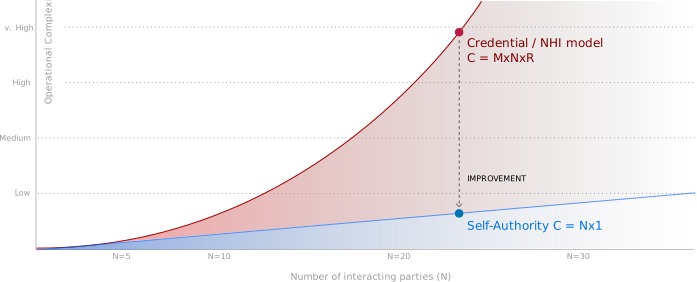
C = N×M×R
The complexity of credential IAM grows geometrically. At 30 interacting parties it is already unmanageable. Self-Authority reduces this to C = N×1 - linear with participants, regardless of scale.
0 Answers
How many NHI or IAM platforms can cryptographically answer: who owns this agent, what were they authorised to do, and what did they do? Zero. The owner-delegate chain does not exist in credential architectures.
The Internet is a social construct. Security in social constructs does not emerge from strength or technological superiority. It emerges from accountability - the principle that every actor is responsible for their actions, and that responsibility is cryptographically inescapable.
Self-Asserted Identity
Each actor self-issues its own cryptographic identity. Not delegated. Not revocable by a third party.
Uniform Model
Human, device, AI agent - one architecture. The owner-delegate relationship is a first-class concept in the identity itself.
Ownership Chain
Delegation cryptographically explicit at every step. Every action traces to an accountable owner - with mathematical certainty.
Connection-Level Auth
Authentication at TCP/TLS before any data. Unknown actors have no surface. The exposure window does not exist.
Identity Plus is built on a premise that separates it structurally from every NHI vendor and every IAM incumbent: the relationship between an owner and the agents acting on their behalf is not metadata - it is the core of the identity model.
Self-asserted uniform identity means that a human, a device, and an AI sub-agent are not three separate identity problems requiring three separate systems. They are three actors in the same cryptographic chain, each identified at the connection layer, each with an explicit and verifiable relationship to the actor above them.
The result is Identity Gated Execution: a state where unknown entities are not monitored, not detected after the fact, but structurally excluded from the execution boundary before connection is ever allowed. No exposure window. No credential rotation. No attack surface for entities that cannot prove both who they are and who they are acting for.
NIS2 - EU - Now
NIS2 requires cryptographic supply chain authentication for critical infrastructure across the EU. €10M fines for non-compliance. The credential model cannot satisfy this at machine scale.
eIDAS 2.0 - EU - 2027
eIDAS 2.0 mandates device-level cryptographic identity across all EU member states. The Self-Authority model was built on this architectural premise years before the regulation was drafted.
CMMC 2.0 - US - 2026
CMMC 2.0 mandates secure authentication for all automated DoD systems. 2FA cannot satisfy machine-to-machine requirements - and Identity Plus is already Awardable on Tradewinds AI.
Simplicity means you move at pace without risk
LEGAL
Copyright © 2026,
Identity Plus, Inc., New Hampshire, USA,
All rights reserved